_edited_edited.jpg)


South Korea Celebrates Buddha's Birthday

Rosa Gulliver of TINYGMUSIC | May 30, 2023
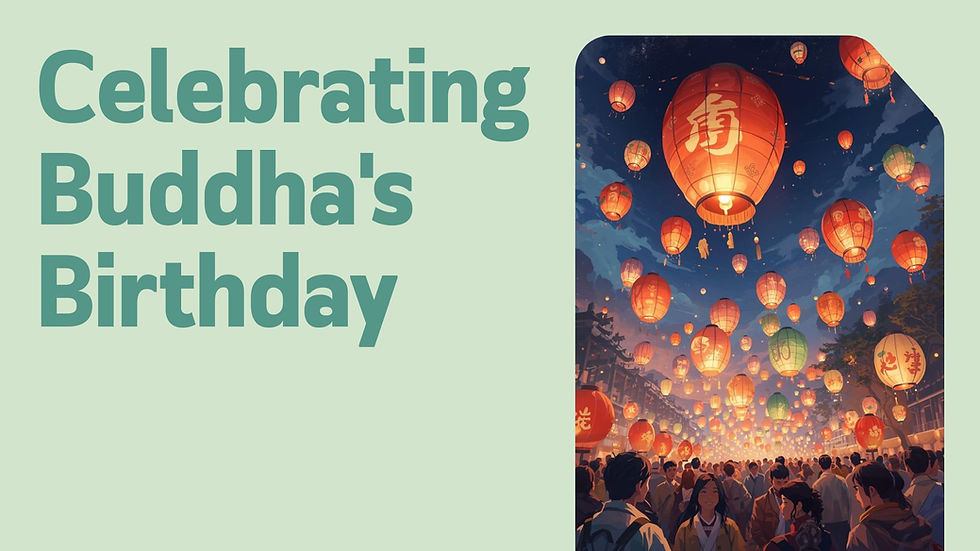
Every spring, millions of South Koreans gather to commemorate the birth of Buddhism's founder, Siddhartha Gautama.
Millions of people, Buddhists, and non-Buddhists alike revel in South Korea's celebration of Buddha's birthday. During the spring months, the country is awash in splendid sights and sounds
Because Buddhism is such a significant historical, religious, and cultural component of Korean society, Buddha's Birthday is commemorated, in such a manner.
Buddha's birthday is observed according to the lunar calendar in Korea. This day is known as "Seokga tansinil" (석가탄신일), which means "Buddha's birthday" or “Bucheonim osin nal” (부처님 오신날) which means "the day when the Buddha came". It occurs on the eighth day of the fourth month of the lunar calendar and varies from year to year. This year the celebration takes place on May 27. It is one of the most significant religious events in the Lunar calendar.
Did you know that South Korea does not have a national religion? The country is a mix of many diverse religions, including Buddhism 불교 (bulgyo), Protestantism 기독교 (gidokkyo), and Catholicism 천주교 (cheon-jugyo) practiced in the country.

Throughout the day, there are parades, performances, and religious ceremonies to honour Buddha and his teachings. People wear traditional Korean clothes and sing traditional songs to celebrate. These performances and ceremonies are a great way to experience the history and culture of Korea. The entire country is illuminated with colourful lanterns that symbolically convey the wisdom and compassion of the sage, while temples host cultural events and dazzling parades.
Not only is Buddha's Birthday significant for the 15 million practicing Buddhists (roughly one-fifth of South Korea's population), but it is also a public holiday (공휴일 gonghyuil) that is widely celebrated across the country when Korean culture and tradition is celebrated.
In Korea, temples are often found in the mountains. On Buddha's Birthday, a large number of Koreans visit these temples 절 (jeol) on Buddha’s Birthday. The temples are transformed into a kaleidoscope of colour. If you visit one of Korea's temples on the day of Buddha's birthday, many temples will serve complimentary meals and tea to all visitors. Breakfast and lunch is often a mixed rice and vegetable meal known as 사찰 비빔밥 (Sachal Bibimbap). You have probably heard of the popular Korean cuisine 비빔밥 (bibimbap), which consists of rice mixed with red pepper paste, veggies, and meat. The Korean temples prepare the 비빔밥 (bibimbap) without meat. It is made instead of fresh vegetables grown naturally, not in greenhouses. The absence of meat in the dish represents a clearing of the mind. Many people visit the temples to eat temple-style bibimbap.
You are able to witness traditional Korean sports and activities such as mask dances, acrobatic acts, watching a gwaebul (huge Buddhist banner painting), and even bathing a baby Buddha statue. Visitors to the temples make wishes as they stroll around the stone towers. Many Buddhist temples host events such as festivals, prayers, traditional sports, and celebrations that are open to the public.

Buddha's Birthday is recognised as the Festival of the Lanterns all across the world. Coloured paper lanterns with candles or light bulbs inside are typically red, pink, and gold. A small paper tag is hung from the bottom of the lantern, and you write your name and a wish or hope that you have in your heart on that tag. You then hang it within the temple. As the lanterns are formed like a lotus, these lanterns are known as lotus lanterns. They are used at the Lotus Lighting Festival, the most famous event on Buddha’s Birthday, 연꽃 축제 (yeonkkot chuk-je).
The Yeon Deung Hoe, commonly known as the Lotus Lantern Festival, is the pinnacle of Buddha's Birthday celebrations. This spectacular event takes place the weekend before Buddha's birthday. The lantern procession starts at 19.00 hours on Saturday and lasts around two and a half hours. This occasion, which dates back more than 1,200 years from the Silla period, is celebrated by Koreans with a spectacular parade. This tradition has carried on through both the Goryeo and Joseon dynasties and remains an important custom to this day.
Lanterns represent enlightenment and the removal of one's anxieties and sorrows in Buddhism. The lighting of the lanterns represents the beginning of a new, brighter future. This ritual has been practiced for generations and is a lovely way to commemorate Buddha's birthday.
The largest lantern festival happens in downtown Seoul, the highlight being the yearly show-stopping procession. Buddhist monks join the general public to parade through the city with magnificent lantern displays, including animated dragons and replicas of the Buddha himself.
Another impressive festival is in Busan at the Samgwangsa Temple [삼광사].
![Samgwangsa Temple [삼광사]](https://static.wixstatic.com/media/7869bc_55469073691a4decb97793c19246bb00~mv2.jpg/v1/fill/w_800,h_363,al_c,q_80,enc_avif,quality_auto/7869bc_55469073691a4decb97793c19246bb00~mv2.jpg)
On Buddha's Birthday, you can not go wrong by visiting a Korean Buddhist temple, whether it is the smallest and newest or the largest and oldest, from Jogye Temple in Seoul to Beomeo Temple in Busan. The most lavish festival, however, may be found at Samgwang Temple (삼광사) in Busan.
Yeondeonghoe is so ingrained in Korean society that it was designated an Intangible Cultural Heritage of Korea in 2012. UNESCO placed the Lotus Lantern Festival on its list of Intangible Cultural Heritage of Humanity in 2020.



Comments